
 Back to blog
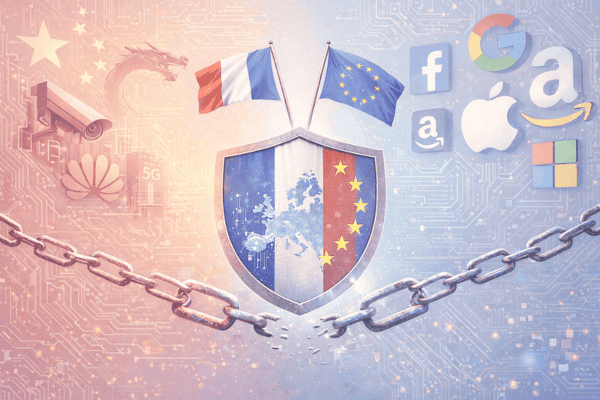
This is among other things what Quentin Adam states in his inspiring talk at Codeurs En Seine last November. I agree with many of his observations; I am concerned to see the unconditional enthusiasm for platforms offered by major foreign players that are too easily adopted. In many cases, has the question of whether an alternative existed even been asked?
Concrete examples
- Email: How many companies use Google Mail or Office 365? Most internet users have an address with a very limited number of providers, giving these providers free rein to constrain standards, collect data, and directly or indirectly blacklist competitors.
- Hosting: Who uses anything other than AWS, Azure or GCP? The CVs I regularly review show that our DevOps engineers proudly present themselves as experts of these platforms.
Why this is problematic
- It makes us dependent on foreign players, whose interests may diverge from our own.
- It makes us vulnerable in terms of confidentiality. Microsoft's representative in France himself clearly stated that he could not guarantee the confidentiality of the data he hosts, even in France, if American authorities requested access.
- It locks us into a way of thinking that limits our imagination and our ability to innovate. As Robert Frost said: "Two roads diverged in a wood, and I — I took the one less travelled by, and that has made all the difference."
The Lockystar approach
At Lockystar, the information system is not dependent on foreign technology. We set up our own email server and collaborative tools (Nextcloud). More broadly, every detail has been designed to offer the greatest resilience, the greatest respect for personal data, and we are committed to contributing to a value system that would allow our country to emancipate itself and regain its sovereignty.
 Download for Free
